Posts

LTE for drone flight management and situational awareness

Image
A nice LTE based drone solution was shown successfully by Nokia in UAE Drones for Good competition in Dubai . It was so nice that Nokia won the Drones for Good Award in the international category. Public safety organizations can use LTE networks - also deployable LTE networks - for new applications and solutions such as unmanned aerial vehicles equipped with video cameras. LTE coverage significantly improves the drone flight control capabilities compared to traditional remote control radios. And at the same time LTE provides broadband capacity for multiple live video streams from drones. It is coming reality that emergency services can use LTE broadband and drones for improved efficiency in firefighting, search & rescue and many other public safety missions. It is important to note that this is possible already now - even before any 3GPP Release 14 mission critical video and robot control features.

Prioritization in commercial network

The market signals from various countries indicate a global trend to start public safety LTE (PS LTE) services together with commercial operators. The benefits are quite obvious i.e. commercial LTE coverage is already widely deployed and PS LTE total cost is reduced when radio access is shared with commercial use. Additionally mobile operators have good spectrum assets. Operators have commonly 50 - 60 MHz FDD spectrum, which makes it quite easy to guarantee adequate capacity for future mission critical broadband services. Mobile operators dimension and design networks for typical need and not necessarily to extreme load such as mass events. So, regardless of available spectrum, commercial mobile networks can get highly loaded or even overloaded. Still in all conditions public safety users must get reliable service access and good quality services. There are various technologies for prioritization like discussed earlier here . You may now ask, what is the news. Well, operators are g...

APNs in MCPTT smartphone

Image
LTE smartphones provide mobile broadband connection to Internet. The prerequisite is that the UE has correct settings, which depend on the mobile operator. Nowadays device vendors and operators have made the use of mobile data so easy that usually users do not need to do any manual configuration. Each smartphone has an internet APN (Access Point Name) configuration, which matches with the operator's network configuration. In general certain APN configuration allows UE to connect (when included in subscription) to certain IP network called packet data network (PDN). So, smartphones know operator's internet APN setting, which enables UE to connect to Internet. Operators have also other APNs and respective PDNs, which offer operator specific services. Some of those services are standardized. On old, still existing service is MMS (Multimedia Messaging Service). MMS is supported by all smartphones and probably automatically configured in all devices and networks. The question is...

The Emperor's New Clothes

This blog is about European spectrum harmonization for BB-PPDR. ECC has created a very nice Report 218 about a year ago with proposals for frequency arrangement for BB-PPDR in CEPT countries. The final report proposes a concept called " flexible harmonization " based on three major elements: common technical standard (i.e. LTE and its evolutions);  national flexibility to decide how much spectrum and which specific frequency ranges should be designated for BB-PPDR networks within harmonised tuning range(s), according to national needs;  national choice of the most suitable implementation model (either dedicated, commercial or hybrid). If we examine the document in more detail, we find various frequency ranges and bands proposed for BB-PPDR. The report has identified following candidates within 400 MHz and 700 MHz ranges: UL 410-420 MHz, DL 420-430 MHz (tuning range) UL 450-460 MHz, DL 460-470 MHz (tuning range) UL 703-713 MHz, DL 758-768 MHz (2 x 10 MHz) ...

Drones, deployable LTE networks and sunshine

Image
It was a very nice and quite warm sunny day today in Espoo, Finland. So it was time to go out with some equipment and other stuff. The list was roughly following: a drone with LTE connection for mission control plenty of drone batteries a smartphone running LTE radio measurement software (carried by the drone) a compact LTE network (eNB + embedded EPC) - about 5 kg a small directional X-pol antenna a small telescope mast for the antenna feeder cables, Ethernet cables, power cables USIMs Windows and Linux PCs (drone control, LTE throughput measurements, LTE network management) a portable AC generator (power for PCs, drone battery charger and LTE network) duct tape screwdrivers a van licenses for flying drones and using LTE spectrum And the questions was that how well the LTE uplink performs when a drone is flying up to 150 meters above the ground. And it worked very well.  Before any results were available, there were of course many problems. The linux PC...

Mission critical LTE in practice

Image
I had a chance to participate the SALUS final validation event, which was arranged on 14. – 15.6.2016 at the Emergency Services College in Kuopio, Finland. Approaching Kuopio. SALUS is a EU funded project studying technologies, networks & business models and developing demo systems illustrating next generation PPDR communication tools. Key enablers for the anticipated new applications and communication methods are broadband radios i.e. LTE and WiFi. A short excerpt from the SALUS final validation event  introduction: “ This event will include a variety of simulated public safety emergency conditions similar to real emergencies, occurring in a specialized 38-hectar-wide training ground. The goal is to prove the need and the advantages of using LTE mobile broadband technology in public safety scenarios whilst still ensuring interworking with Wi-Fi, TETRA and TETRAPOL technologies. Many key functionalities, such as push-to-talk, group communications, messaging, video str...

TETRA+LTE smartphone

Image
Airbus has launched a new handset, which combines TETRA radio for group voice communication and LTE for broadband data. The product is called Tactilon Dabat . Very little information is available yet. It has 4.7 inch touch screen. It has normal TETRA handset features including PTT button, loud audio and rugged hardware with IP65 & IP67 rating. Security of the smartphone is covered simply stating that all data within the device is encrypted. Nothing is said about the LTE features. Very likely the LTE band selection matches with common commercial LTE bands in TETRA markets. Because the announcement does not highlight LTE features it probably does not have any of the 3GPP mission critical features like release 12 QCIs. So the device has two radios, which can be used simultaneously. Therefore the current consumption could be an issue especially, if the applications use LTE radio frequently during missions. Battery capacity is not yet known except it is "long-lasting...

Robots for public safety

Image
3GPP has started working on release 14 content. Public safety will again get enhancements especially on application layer. Mission critical push to talk (MCPTT) was specified in release 13 and next 3GPP introduces mission critical video and mission critical data service. Both include group communication capabilities i.e. group calls with video and group messaging. However the interesting thing is use cases considering various unmanned vehicles or even robots that require highly reliable, low latency and secure connection for remote control and live video streaming. Let's first check what kind of "things" 3GPP expects to be relevant for first responders. Unmanned aerial vehicles (UAV) a.k.a. drones are nowadays common even as consumer toys. What is not common is the idea to control the drones and transmit live video over LTE. Remote flight control understandably requires low latency. Furthermore live video feed from the 360 camera of the drone needs to be real time espec...

MCPTT latency requirements

Image
Mission critical communication has strict performance requirements for the push-to-talk (PTT) voice calls. The groups calls should be of course established as soon as possible, but the most important thing is that floor control is 'instant' and mouth-to-ear voice delay is minimal during mission critical PTT calls. 3GPP 22.179 specifies some key performance indicators (KPI), and the interesting ones are: MCPTT access time (KPI 1) Mouth-to-ear latency (KPI 3) The figure below (from 22.179) illustrates the definitions of these two KPIs. The same specification defines also target values for these KPIs. The exact definition includes some probabilities and assumptions, but in order to keep it simple we need just to remember that KPI 1 should be less than 300 ms and KPI 3 should be also less than 300 ms. One might ask whether LTE networks can guarantee such low latency targets. Well, these figures are actually coming from the existing 'oldish' legacy systems like T...

Isolated E-UTRAN operation for public safety

Image
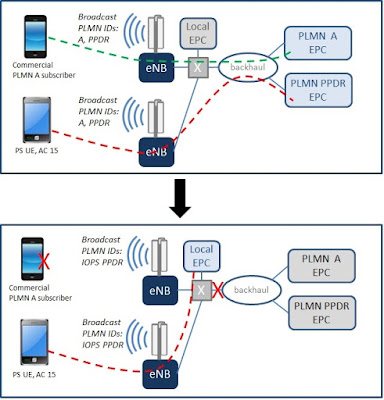
Updated 24.5.2016 Resiliency and service availability can be enhanced in terrestrial public safety LTE network based on capability called 'Isolated E-UTRAN Operation for Public Safety (IOPS)'. IOPS enables local services in case backhaul connection to centralized macro core is lost. IOPS assumes that local EPC function is co-sited with eNodeB. Local EPC can serve also multiple eNodeBs. Local EPC includes at least HSS, MME, SGW and PGW functions. The figure below depicts an example of shared RAN, which is serving both PS users and commercial subscribers. There are separate PLMN identities for commercial customers (PLMN 'A')  and PS customers (PLMN 'PPDR') and there are also separate core networks. In normal condition commercial and PS subscribers are attached to their own centralized core networks and all data connectivity and communication services are provided by the centralized core networks. The lower part of figure depicts a transmission failure in backh...

Public Safety D2D devices to Korean market

Although 3GPP specified Proximity Services (ProSe) including direct communication for public safety already in release 12 (2015) there has been quite little evidence about real implementations. Qualcomm's interest seems to be more in commercial use cases based on the discovery functions of ProSe. Explanation is very likely the much higher volumes in consumer devices and applications compared to potential special public safety device volumes. However now there are some English and Korean language news, which seem to indicate that Samsung is developing 3GPP direct communication (or device-to-device, D2D) for Korean market. Korea has been active in driving public safety LTE as the first significant market. The initial pilot phase of the public safety LTE network has been awarded to SK Telecom and KT .

Out of terrestrial network coverage

Image
Updated 9.4.2016 Public safety terrestrial network coverage may not be always available for mission critical communication because of many reasons. Coverage may be missing by design in uninhabited areas, but temporary communication solution might be needed for example due to a forest fire. Some indoor or underground locations such as tunnels, basements and caves may not have coverage available. There could be also network outage due to natural disaster or broken transmission link. Still public safety users need communication solutions in case of an emergency. Temporary coverage can be provided with deployable systems. Such a system can be fully standalone network without any connection to external networks or there can be a suitable transport connection for example over satellite to connect deployable eNB to a centralized core network. Deployable systems can also vary in coverage & capacity from large macro eNB with multiple sectors to a small micro or pico cell. The figure b...

Mission Critical Push To Talk and EPS bearers

Image
Mission critical push to talk architecture defines several reference points and uses multiple protocols over different EPS bearers. 23.179 specifies that UE connets to MCPTT specific APN in order to use MCPTT service. It is defined that SIP signaling uses QCI 69 bearer. Additionally HTTP is used for signaling. 23.179 defines also that QCI 8 or better is used for HTTP messaging. Voice media is transmitted over secure RTP either using unicast GBR QCI65 bearer or optionally in multicasting downlink media over MBMS GBR QCI65 bearer. Same bearer (unicast or multicast) is used also floor control. Following figure depicts how these MCPTT reference points can be mapped to unicast and multicast bearers. Although the 23.179 states that SIP and HTTP can be mapped to different unicast bearers that have different QoS, it can be also interpreted that QCI69 is better than QCI8 and therefore it should be possible to carry both SIP and HTTP signalling over the default QCI69 bearer. After LT...

Happy New Year!

Love, peace and rock & roll. Click and enjoy. Enjoy 1 Enjoy 2 Enjoy 3

Public Safety smartphones

Image
When do we get LTE smartphones for public safety? Well, one could say that we already have LTE smartphones for public safety. Both ruggedized devices designed for public safety users as well as commercial off-the-shelf running group communication applications. However currently available devices do not yet support new 3GPP Release 12 and 13 features specified for public safety. Requirements for public safety handsets vary depending on use cases. Certain first responders like firefighters need tough devices resistant to shocks, heat, water, smoke, dust and so on. Electric devices have to support use even in explosive environment [ ATEX ]. Furthermore it must be possible to operate devices in noisy environment wearing protective uniform and gloves. The user interface should support group communication with push-to-talk button. Additional safety features are important like emergency button as well as support for man-down detection and alarm. On the other hand many users can also wor...

Public Safety prioritization

Image
LTE QoS and prioritization for mission critical communication Public safety (PS) users have the most stringent requirements for network & service accessibility and service quality. Various mechanisms can be used to fulfill these requirements in different network conditions. Those mechanisms must be able to differentiate both users and applications based on certain priorities.  PS users can have different priority levels, which can also change dynamically. For example paramedic engaged in emergency mission has a higher priority than policemen on a lunch break. LTE networks can be shared serving both PS users and commercial subscriber with same resources (e.g. same carriers), in which case there is also a need to prioritize PS users over regular subscribers. Key reason for adopting LTE for mission critical communication is of course broadband capability for data applications. At the same time LTE certainly supports also voice calls (both group calls & one-to-one ca...

Spectrum

Spectrum for Public Safety LTE Legacy PPDR (Public Protection and Disaster Relief) systems have limited mobile data support and therefore authorities globally plan evolution towards next generation public safety (PS) communications with mobile broadband capability. LTE is the choice for the first globally common technology for public safety i.e. current TETRA, Tetrapol and P25 systems will be gradually migrated to LTE [ TCCA ,  APCO ]. Although few countries have already started projects to deploy LTE based mission critical communication systems, it will take quite some time before significant number of governments will invest in new LTE based systems. For example Germany has just been finalizing its nationwide TETRA network in end of 2015 [ BOSnet ], so it is hard to expect any German federal government budget for a new network deployment in near or mid term. Legacy PPDR systems have been deployed on dedicated spectrum. For example TETRA is often running on 400 MHz...